Hiring is no longer only about posting a job and waiting for applications. Employers now need faster systems, better teamwork, stronger candidate review, and careful use of technology. A smart hiring team is not built only with more people.
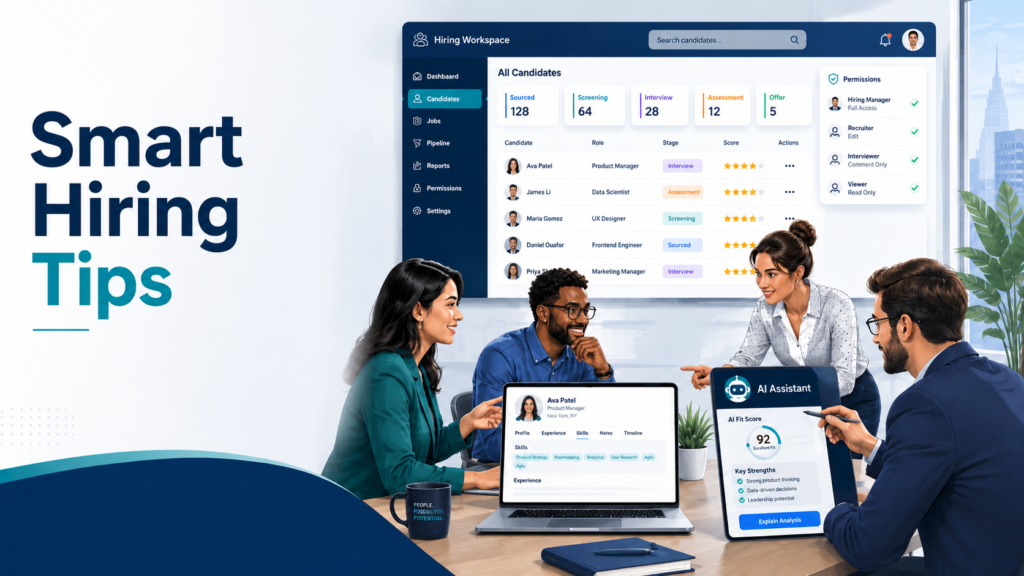
Talent-traffic jam happens when companies add more recruiters, HR staff, and department managers without clear access, roles, and responsibilities. Smart hiring platforms reduce that chaos by helping teams add users quickly, assign permissions, search CVs, review candidates, and communicate with applicants without slow manual approvals.
| Hiring Area | What Smart Teams Need | Example |
| Tools | Fast access to hiring platforms and candidate databases | Add recruiter seats, assign permissions, and track usage |
| Teamwork | Clear shared goals and communication | Everyone knows the role, deadline, and candidate requirements |
| AI Control | Human review of AI-supported screening | AI can shortlist, but recruiters should verify final suitability |
| Compliance | Fair and documented hiring process | Keep records of candidate review, communication, and selection reasons |
Me-first hiring creates confusion when recruiters work separately without a shared goal, clear candidate criteria, or a common deadline. A strong hiring team works with a we-mindset, where everyone understands the role, required skills, business purpose, and timeline, making recruitment more accurate and organized.
A smart hiring process should include clear job requirements, candidate sourcing, CV screening, document checking, interview coordination, employer feedback, final selection, onboarding support, and compliance records.
Important points for smarter hiring teams:
Clear access control: Give the right platform access to the right team members. For example, a recruiter may need CV search access, but an admin may only need reporting access.
Shared hiring purpose: Explain why the role matters and what kind of candidate is needed. So, instead of saying “find warehouse workers,” mention experience numbers like shift, location, physical requirements, and document needs.
Human review of AI results: Use AI to support screening, not to make the final decision alone. As a result, if AI rejects a candidate because of missing keywords, a recruiter should still check actual experience.
Documented decision-making: Keep records of why candidates were shortlisted or rejected. For Instance, note missing certificate, weak experience match, salary mismatch, or incomplete documents.
AI is now another major part of hiring. Many companies use AI tools for screening resumes, ranking candidates, writing job descriptions, or matching skills. There are 3 main controls every hiring team should follow.
- First, AI should only support the first level of screening.
- Second, a human recruiter should review candidate experience, documents, skills, and job readiness.
- Third, the company should keep a written record of how the final decision was made.
Recruiters should check whether the AI result makes sense. They should compare the candidate’s real experience, documents, skills, communication ability, and job readiness before submitting or rejecting a profile. If AI is used without control, it can damage trust with candidates and increase legal risk for employers. Responsible AI use means keeping human judgment at the center of recruitment.
For recruitment firms this trend is very important. Employers want fast hiring support, but they also want reliable and compliant candidate screening. Agencies should focus on building verified candidate databases, clear internal task systems, and careful review processes. Companies that use AI without human review may face trust and compliance issues. But companies that combine digital speed with human judgment will be in a stronger position.