
How Smart Hiring Teams Use Better Tools, Teamwork, and AI Control
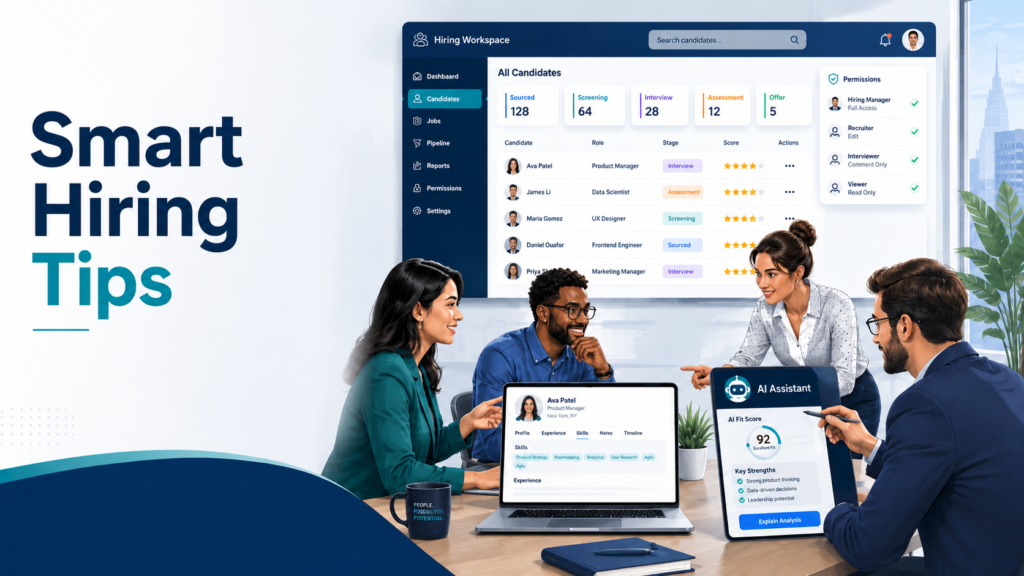
Hiring is no longer only about posting a job and waiting for applications. Employers now need faster systems, better teamwork, stronger candidate review, and careful use of technology. A smart hiring team is not built only with more people. Talent-traffic jam happens when companies add more recruiters, HR staff, and department managers without clear access, roles, and responsibilities. Smart hiring platforms reduce that chaos by helping teams add users quickly, assign permissions, search CVs, review candidates, and communicate with applicants without slow manual approvals. Hiring Area What Smart Teams Need Example Tools Fast access to hiring platforms and candidate databases Add recruiter seats, assign permissions, and track usage Teamwork Clear shared goals and communication Everyone knows the role, deadline, and candidate requirements AI Control Human review of AI-supported screening AI can shortlist, but recruiters should verify final suitability Compliance Fair and documented hiring process Keep records of candidate review, communication, and selection reasons Me-first hiring creates confusion when recruiters work separately without a shared goal, clear candidate criteria, or a common deadline. A strong hiring team works with a we-mindset, where everyone understands the role, required skills, business purpose, and timeline, making recruitment more accurate and organized. A smart hiring process should include clear job requirements, candidate sourcing, CV screening, document checking, interview coordination, employer feedback, final selection, onboarding support, and compliance records. Important points for smarter hiring teams: Clear access control: Give the right platform access to the right team members. For example, a recruiter may need CV search access, but an admin may only need reporting access. Shared hiring purpose: Explain why the role matters and what kind of candidate is needed. So, instead of saying “find warehouse workers,” mention experience numbers like shift, location, physical requirements, and document needs. Human review of AI results: Use AI to support screening, not to make the final decision alone. As a result, if AI rejects a candidate because of missing keywords, a recruiter should still check actual experience. Documented decision-making: Keep records of why candidates were shortlisted or rejected. For Instance, note missing certificate, weak experience match, salary mismatch, or incomplete documents. AI is now another major part of hiring. Many companies use AI tools for screening resumes, ranking candidates, writing job descriptions, or matching skills. There are 3 main controls every hiring team should follow. Recruiters should check whether the AI result makes sense. They should compare the candidate’s real experience, documents, skills, communication ability, and job readiness before submitting or rejecting a profile. If AI is used without control, it can damage trust with candidates and increase legal risk for employers. Responsible AI use means keeping human judgment at the center of recruitment. For recruitment firms this trend is very important. Employers want fast hiring support, but they also want reliable and compliant candidate screening. Agencies should focus on building verified candidate databases, clear internal task systems, and careful review processes. Companies that use AI without human review may face trust and compliance issues. But companies that combine digital speed with human judgment will be in a stronger position.
Africa and North Africa: Compliance-First Market Entry

Across Africa and North Africa, major labor markets include Morocco, Egypt, Nigeria, Kenya, and South Africa. Employers and international candidates should understand that entry requirements vary significantly by country. South Africa generally uses the Critical Skills Visa or General Work Permit routes. Morocco requires ANAPEC validation and approval from the Ministry of Labor before a work permit can be issued. In Egypt, legal employment requires NWRA work permit processing. Nigeria, one of the region’s fastest-growing economies, uses the Expatriate Quota and CERPAC systems, including procedures introduced under recent reforms. Foreign nationals seeking employment with a Kenyan company generally require a Class G Work Permit. Africa and North Africa offer substantial workforce opportunities, but market entry must follow a compliance-first model. The region is not a single labor market. Morocco, Egypt, Nigeria, Kenya, and South Africa each maintain different permit systems, documentation rules, contract-language requirements, tax obligations, and employer-side responsibilities. High-potential employment sectors Sector Construction Energy Industrial projects Hospitality Facility management Logistics Technical services These sectors can create meaningful opportunities for qualified international workers, particularly where employers face verified local skills shortages. However, workforce demand alone does not guarantee that foreign recruitment will be permitted. Before beginning recruitment, employers must confirm that they have the legal capacity to sponsor foreign workers. They must also verify the correct permit category, candidate qualifications, employment conditions, document requirements, and expected processing timelines. Local-content requirements, union exposure, document legalization, work-authorization timelines, and data-protection laws may also affect project speed and recruitment planning. These requirements should be reviewed before candidate sourcing or formal job offers begin. The most practical strategy is to start with countries that offer clearer employer-sponsorship systems and defined work-permit procedures. Employers can then expand gradually after completing legal review, verifying clients, and establishing compliant recruitment processes. References and further guidance Morocco Work Permit and ANAPEC RequirementsIBN Immigration Solutionshttps://www.ibn.co.za/morocco/work-permit/ South Africa Critical Skills Work Visa RequirementsDepartment of Home Affairs, Republic of South Africahttps://www.dha.gov.za/images/notices/8october24/Critical_Skills_work_Visa_requirements_-_8_Oct_2024.pdf Nigeria Employment Visa—Expatriate Quota, R2ANigeria Immigration Servicehttps://immigration.gov.ng/info-center/employment-visa-expatriate-r2a/
Building trust in a tough job market starts with profile and resume quality

The trust gap is growing in today’s job market as many candidates face slower hiring and stronger competition. A strong hiring process now needs 2 basics: a complete employer profile and a clear candidate resume. Employers may review hundreds of polished resumes, but many fail to show real skills, work history, and job readiness. When both sides look professional, honest, and easy to verify, recruitment becomes smoother, faster, and more trusted. Why trust matters in a tough job market Trust pressure rises when job seekers doubt whether a company is real and employers doubt whether a candidate is truly job-ready. In a tough job market, candidates avoid weak company profiles, while employers skip resumes that look generic, exaggerated, or unclear [1]. This slows the recruitment process and makes hiring less effective for both sides. For recruitment agencies, trust matters even more because they must present clear employer information and strong candidate profiles to protect confidence on both sides. A Strong Company Profile Builds Candidate Confidence Profile confidence gap is bigger in a tough job market because candidates are not only checking the job title; they are checking whether the employer looks real, active, and trustworthy. Kelly’s briefing said jobs have not felt this hard to get since 2021, and another briefing noted that 95% of job seekers said they had seen a scam job offer. In this situation, a complete company profile becomes a basic trust signal before a candidate applies. [2] For recruitment agencies, this matters even more. If an agency shares a job with missing employer details, weak branding, or unclear contact information, candidates may hesitate. In a market where almost 70% of workers reportedly did not receive a raise in the past six months and job seekers are more cautious, a clear profile, official email, active website, and consistent branding can make the opportunity look more reliable. Resume quality matters more than resume design Many resumes look polished because candidates use templates and AI tools. However, a good design does not prove real skills or experience. Employers need clear details about job duties, achievements, certificates, and practical skills. A strong resume should explain what the candidate did, how long they worked, and which tools or machines they used. AI can improve structure and writing, but it may make resumes sound generic or exaggerated. Human review is still needed to confirm experience, documents, and job readiness. What a Trustworthy Candidate Profile Should Include A strong candidate profile should be simple, clear, and verified. It should not only repeat the resume but summarize the candidate in a way that helps the employers to make a quick decision. Profile Area What to Include Why It Matters Job Role Main position or target role Helps employer match the candidate quickly Work Experience Years, duties, and work environment Shows real job readiness Skills Technical and practical skills Helps compare with job requirements Certificates Training, license, or professional documents Supports credibility Language Ability English, Arabic, Japanese, Korean, or other language level Important for international hiring Document Status Passport, CV, certificates, medical readiness, references Helps avoid delays Country Preference Preferred destination or job market Helps recruitment planning How to build recruitment trust before sharing a candidate Trust leakage starts when an employer profile looks incomplete or inconsistent. A strong employer profile should present at least 5 trust signals: the same company name, logo, phone number, official email, and website across LinkedIn, Bayt, Google Business Profile, and proposal emails. Consistent employer branding improves recruitment trust and helps candidates identify genuine job opportunities [3]. A profile mirage appears when a polished resume looks impressive but does not show real experience. Strong resume quality means listing specific duties, tools, skills, and work history; for example, replace “factory worker” with “machine operation, packing, quality checking, and production-line support.” AI-written resumes may improve formatting, but recruiters should verify leadership claims, technical skills, certificates, and actual job responsibilities through human review [4]. Before sharing a candidate, recruiters should complete 3 essential checks: confirm that experience matches the job, identify whether documents such as passports, certificates, references, and medical records are ready or pending, and make sure the candidate understands the location, shift, salary range, and work conditions. This candidate screening process reduces confusion, improves hiring quality, and protects trust between employers, candidates, and recruitment agencies. In conclusion, recruitment firms should focus on building verified candidate databases, improving resume quality, checking documents, and maintaining professional employer profiles. This creates a stronger position in a difficult job market. Agencies should also avoid overpromising. If a destination market is not open, employer demand is not verified, or documents are incomplete, the agency should communicate clearly. Trust grows when information is accurate, transparent, and easy to verify. Sources: Bayt.com — Company Profile Qualityhttps://www.bayt.com/en/employers/blog/32551/first-impressions-matter-a-stronger-company-profile-starts-with-the-basics/ Korn Ferry CEO — Resume Quality and AI-Written Resumeshttps://www.kornferry.com/jp/insights/special-edition/a-resume-redux Kelly — Jobs Haven’t Felt This Hard to Get Since 2021https://www.kellyservices.com/need-to-know-briefing-july-6-26 Kelly — 2 Million Jobless, Six Months Runninghttps://www.kellyservices.com/need-to-know-briefing-july-20
The FIFA World Cup 2026 Is Over: What Should Job Seekers Do Next?

The FIFA World Cup 2026 ended on July 19 after bringing together fans, teams and workers across 16 host cities in the United States, Canada and Mexico. Behind the tournament were people working in hospitality, transportation, security, logistics, catering, cleaning, retail, customer service and venue operations. Now that the final whistle has blown, many temporary and event-based contracts are ending. For job seekers, this may feel like a significant hole in the employment market. However, the end of the tournament does not mean the end of opportunity. It means that workers must reposition their experience for the next stage of their careers. What Employment Gap Has FIFA Left Behind? Major sporting events create a sharp but temporary increase in hiring. Hotels need additional staff, venues require crowd-support teams, transport companies add drivers and coordinators, and contractors recruit workers for merchandising, catering, cleaning and event logistics. After the event, these employers usually return to their normal staffing levels. Workers in tournament-specific positions such as fan-zone support, accreditation, temporary retail, shuttle coordination and match-day guest services may experience the fastest reduction in available hours. Competition may also increase because many temporary workers begin searching for their next job at the same time. The solution is to act quickly and look beyond positions carrying the “FIFA” or “World Cup” name. Your FIFA Experience Still Has Value Working during a global event demonstrates more than an interest in football. It can show employers that you are able to: These are transferable skills. They can be useful across hospitality, tourism, logistics, warehousing, aviation, facilities management, security, retail and other service industries. warehousing, aviation, facilities management, security, retail and other service industries. Which Sectors Should You Target Next? Former tournament workers should consider applying in industries that require similar skills: In the United States, the Bureau of Labor Statistics projects construction and extraction occupations to grow faster than the average for all occupations between 2024 and 2034, with approximately 649,300 openings each year. This makes skilled trade training another practical pathway for eligible job seekers. Treat FIFA as a strong chapter in your career, not the entire story. Your next role may be in a hotel, warehouse, airport, stadium, construction project or another major event, and the skills you developed during the World Cup can help you get there.
Most In-Demand Blue-Collar Jobs in 2026
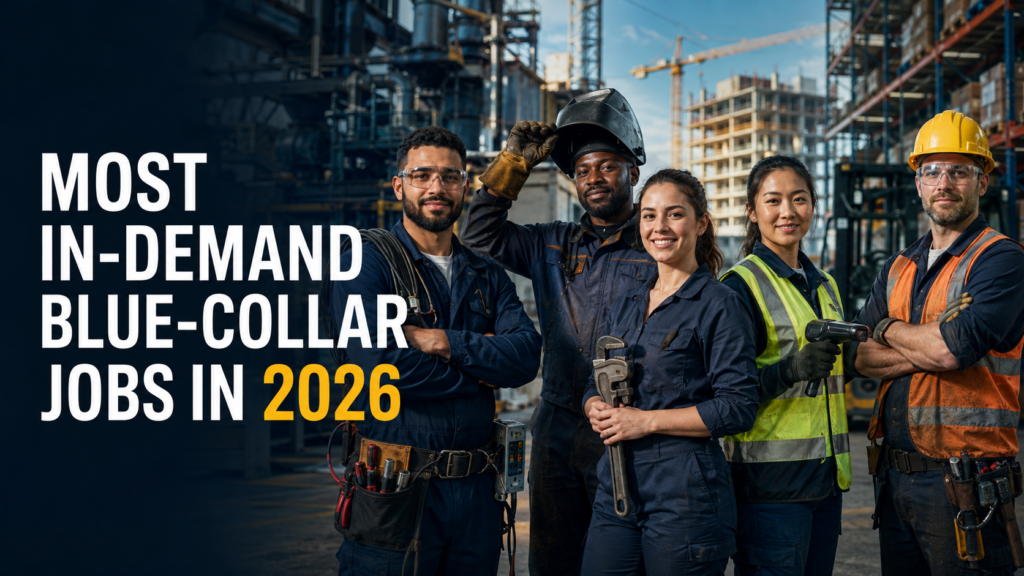
August 1, 2026 Blue-collar jobs remain essential in 2026 as construction, logistics, manufacturing, energy, warehousing, and infrastructure projects continue to expand worldwide. Employers increasingly need skilled and job-ready workers who can support daily operations. Demand remains strong for workers in practical and technical occupations, including: Electricians Welders HVAC technicians Plumbers Machine operators Commercial and delivery drivers Warehouse workers Mechanics Construction workers Forklift operators Maintenance technicians Packaging and production workers These positions are important across construction sites, manufacturing facilities, logistics centers, warehouses, transportation networks, and commercial service operations. Skills and certifications improve opportunities Workers with recognized technical certifications, workplace safety training, equipment-operation experience, and proven employment history may have access to stronger career opportunities. Employers often prioritize candidates who understand job-site safety, can follow instructions, operate tools or machinery properly, and maintain consistent productivity. Practical qualifications such as trade certifications, commercial driving credentials, welding training, machinery-operation experience, and occupational safety courses can help candidates become more competitive. Where demand is growing Blue-collar labor demand is especially visible across the United States, GCC countries, Europe, Asia, and other fast-growing markets. Construction expansion, industrial development, supply-chain activity, renewable-energy investment, and infrastructure modernization continue to create demand for reliable workers across multiple sectors. GlobalRAWS helps connect employers with suitable candidates based on verified job requirements and available opportunities. Recruitment outcomes depend on employer demand, candidate eligibility, and applicable employment regulations. Sources and references U.S. Bureau of Labor Statistics — Occupational Outlook Handbookhttps://www.bls.gov/ooh/ International Labour Organization — Construction sector and workforce skillshttps://www.ilo.org/topics-and-sectors/industries-and-sectors/construction International Organization for Migration — Improving Access to Labour Market Information for Migrants and Employershttps://publications.iom.int/books/improving-access-labour-market-information-migrants-and-employers
The U.S. Home Care Workforce Boom: Why Employers Must Plan Earlier

BLS projects home health and personal care aide employment to grow 17% from 2024 to 2034, adding about 739,800 jobs.
Latin America Workforce Outlook 2026: Slow Growth, Selective Opportunity

The World Bank projects Latin America and the Caribbean to grow 2.1% in 2026, below the 2.4% growth recorded in 2025.
Malaysia: Manufacturing, Plantation, Construction, and Services Opportunity

Malaysia’s key labor-demand sectors include manufacturing, plantation, construction, and services.
Singapore: A Premium Market for Regulated Workforce Deployment

Singapore’s construction demand is projected at SGD 47-53 billion in 2025, with an estimated 15% construction workforce shortfall in 2026.
UAE: Construction, Logistics, Healthcare, and Service Growth

UAE demand is led by construction, nursing, logistics, healthcare, hospitality, and caregiver roles. Employer obligations include MOHRE work permit compliance, WPS salary payment, medical insurance, and employer-paid visa/recruitment costs.