
Why global labour shortages continue: skills, safety and childcare matter

By GlobalRAWS Research Team Published: August 31, 2026 A labour shortage does not always mean that a country has too few people. The real problem may be missing skills, weak training systems, unsafe workplaces, poor job matching, or a lack of childcare. Evidence from Germany, the United States, Vietnam, Nigeria, Malaysia, Australia, and South Africa shows that worker shortages have many different causes. Germany Has Workers, but Not Always the Right Match Germany’s official skilled-worker portal identifies strong demand for nurses, doctors, engineers, IT specialists, craftspeople, transport workers, and green-energy professionals. However, Germany’s Economy Ministry says the country does not have a nationwide shortage in every occupation. The gaps are concentrated in particular sectors and regions. At the same time, up to 1.2 million people aged 15 to 29 may be outside employment, education, or training. This estimate depends on the age group and statistical definition used. This is a skills-matching problem. Available workers may lack the qualifications, language ability, location, or support needed for open jobs. US Trades Need More Trained Workers A 2026 Lightcast study estimated a shortage of 1.3 million skilled-trade workers in the United States. The study identified around 2.1 million openings each year, with roughly three openings for every person completing a relevant training programme. Retirements were estimated to create about 40 percent of annual openings. These figures are an industry estimate, not an official vacancy count. However, they show why apprenticeships, technical education, and certification are important. Vietnam Has Orders but Lacks Technical Skills Supporting-industry companies in Hanoi report that worker shortages are affecting production. Tomeco planned to recruit around 160 workers for a new factory but had hired only about 70. The company said some orders could not be completed on schedule because it lacked enough trained workers. Technical employees may need months of workplace training before they can meet production and international quality standards. Automation also means workers must operate, monitor, and maintain new systems. The problem is therefore not only finding people. It is finding people who can perform the job. Safety Is Driving Healthcare Workers Away Nigeria’s kidnapping crisis is adding to its healthcare staffing problems. BusinessDay, citing the Safeguarding Health in Conflict Coalition, reported that 91 health workers were kidnapped and 15 were killed across 101 incidents between 2023 and 2025. Insecurity can force medical workers to leave rural facilities or move abroad. When one health worker disappears from a poorly staffed community, thousands of patients may lose access to care. Specialist training also matters. A CodeBlue commentary described how Malaysia’s private dialysis centres depend on nurses with post-basic renal qualifications. These nurses manage complex machines, vascular access, and life-threatening emergencies. Losing one specialist nurse is not the same as losing a worker who can be replaced quickly. Childcare Is Also Workforce Infrastructure Some parents cannot enter or remain in employment because childcare is unavailable or too expensive. Australian Bureau of Statistics data showed that around 700,000 parents with children under 15 were out of work in 2022 to 2023. About 85 percent were mothers. Caring for children was the main barrier reported by many parents. Among mothers who wanted work or more hours but were unavailable, about 28 percent said childcare was unavailable, fully booked, or absent from their area. A 2026 US analysis found that 46 percent of children aged five and under lived in licensed childcare deserts in 2025. The share exceeded 70 percent in rural communities. South Africa Disputes the Simple Shortage Story South Africa’s Labour Minister, Nomakhosazana Meth, rejected the claim that South Africans are unwilling to work. She argued that the larger problem is a shortage of employment opportunities. The government still accepts that some critical skills are scarce. However, it wants employers to recruit locally first and use foreign workers lawfully when genuine gaps remain. This shows why shortage claims require occupation-level evidence. High unemployment and shortages in specific professions can exist at the same time. The Main Lesson Worker shortages require more than recruitment. Effective responses may include: A shortage report is not automatic permission to recruit internationally. Employers must still follow local-hiring rules, professional licensing, immigration requirements, and worker-protection standards. Sources
The global healthcare staffing crisis: lessons from Sarawak, Australia and Florida

Healthcare worker shortages are appearing in very different regions. The causes include ageing populations, unfilled rural posts, limited training capacity, professional licensing, and workers leaving difficult jobs. The evidence from Sarawak, Australia, and Florida shows that one recruitment campaign cannot solve the global nurse and doctor shortage. Sarawak has current public-sector vacancies Malaysia’s Health Ministry reported major healthcare gaps in Sarawak as of June 30, 2026. The public system had vacancies for: The vacancy rates were 30 percent for medical officers, 28 percent for specialists, and 15 percent for nurses. Sarawak also reported a 43 percent no-show rate among medical officers offered permanent positions in the previous year. This suggests that offering jobs is not enough. Location, working conditions, career development, and retention also matter. Australia shows a wider skills problem Australia’s 2025 Occupation Shortage List found that 29 percent of assessed occupations were in shortage. Nearly half of trade roles and two in five professional occupations remained in shortage. Health, education, and construction were among the main pressure areas. The Australian data is a point-in-time labour-market assessment. It does not mean that every healthcare occupation is open to international recruitment. Employers, immigration authorities, and professional regulators apply separate rules. Healthcare workers must normally complete professional registration before they can practise. Florida’s figures are forecasts Florida’s healthcare numbers should be described as future projections, not current vacancies. A workforce analysis cited by Florida State University projected that the state could face a shortage of about 18,000 physicians and nearly 60,000 nurses by 2035. Florida’s population is growing and ageing. Many existing doctors and nurses are also approaching retirement. These changes are expected to increase demand while reducing part of the current workforce. Rural North Florida faces an additional problem. Some communities already have limited access to primary and specialist care. A state may have many professionals in major cities while rural areas remain seriously underserved. Training capacity limits the supply Healthcare workers need years of education and supervised clinical experience. A shortage cannot be solved by adding classroom seats alone. Important training barriers include: The Florida Center for Nursing has identified faculty, preceptor, workload, mentoring, and compensation problems as barriers to increasing the nursing workforce. This means the supply pipeline can remain slow even when many students want to enter nursing. International recruitment has strict conditions International recruitment can support countries with genuine shortages. However, a foreign qualification does not automatically provide permission to practise. For example: Depending on the profession and destination, applicants may need qualification verification, language testing, licensing examinations, supervised practice, or local orientation. Recruitment must be ethical Hiring from another country can fill one gap while creating another. The World Health Organization’s Global Code asks destination countries to consider the effect of recruitment on source-country health systems. The Code was amended in May 2026. The changes included care workers and encouraged co-investment so that worker mobility benefits both source and destination countries. A responsible international recruitment programme should include: The summary Healthcare shortages are not only recruitment problems. They are also training, licensing, distribution, and retention problems. Sarawak needs workers in its public facilities today. Australia’s shortage list shows wider pressure across skilled occupations. Florida is preparing for large projected gaps by 2035. The strongest response combines local training, better working conditions, rural incentives, professional licensing, ethical international recruitment, and long-term retention. Sources Malaysia medical registration requirements
Scam-Proof your overseas job search: 10 checks before you pay or travel

A genuine overseas job should be supported by documents that can be checked independently. A company logo, visa image, social-media post, or agent’s promise is not enough. Recent cases involving irregular Malaysian work passes and false UAE notices show that even official-looking information can be misleading. Complete these ten checks before paying money or travelling. 1. Verify the recruiting agency Confirm that the agency has a valid recruiting license. Check the legal name, license number, office address, and authorized representative through BMET or the Ministry of Expatriates’ Welfare and Overseas Employment. Do not hand documents or money to an unknown sub-agent. 2. Confirm the Employer Ask for the employer’s: Contact the employer through independently found details. Do not rely only on a number supplied by the recruiter. 3. Match the visa to the job The visa or permit must authorize the promised work. A tourist, visit, pilgrimage, or short-stay visa is not a normal work permit. The employer’s name, occupation, and destination shown on the documents should match the employment offer. 4. Check the employer’s approval For Malaysia, the employer normally obtains foreign-worker approval and applies for the Visa With Reference. Malaysian Immigration states that workers may enter only after the required approval and entry visa are issued. Ask for the approval reference. Then confirm it through an official system or authority where possible. 5. Read the Full Contract The contract should clearly state: Do not sign a blank, incomplete, or untranslated contract. 6. Get a written cost schedule Ask for an itemized list of every permitted cost before paying. Pay only through an authorized channel. Collect a receipt showing the amount, date, purpose, agency name, and payer’s name. BOESL has warned candidates not to pay commissions to agents or use unofficial payment channels for BOESL recruitment. 7. Verify medical and emigration clearance Complete medical examinations only through approved centres. Confirm BMET registration, emigration clearance, pre-departure requirements, and any required skills assessment independently. A recruiter should not control the only source of information. 8. Do not trust screenshots alone Malaysia investigated 1,306 Temporary Employment Visit Passes that were reportedly approved irregularly through the MyIMMs system. The Immigration Department later said the affected passes would be revoked. This shows why one online result should not be treated as complete proof. The employer, quota, contract, visa, and recruiter must all match. 9. Keep Copies of Everything Save digital and printed copies of: Give copies to a trusted family member before departure. 10. Stop when you see pressure Pause the process if someone: Information Matters The Bangladesh Embassy in Abu Dhabi warned that false UAE notices were circulating with government logos, official emblems, the national flag, and even the embassy’s email address. A familiar logo does not prove that an announcement is genuine. Workers should use BMET, BOESL, Bangladesh missions, destination-country immigration authorities, and other official sources. The safest rule is simple: every promise should match a document, a responsible authority, and an independent verification step. Sources
Skills certification is becoming the ‘new passport’ for global blue-collar work

By GlobalRAWS Research TeamLast reviewed: August 29, 2026 A passport and visa allow a worker to travel legally. But they do not prove that the worker can weld a pipe, repair a machine, care for a patient, or operate industrial equipment. Employers increasingly want clear proof of skills. For many overseas jobs, verified ability is becoming as important as travel documents. Not every certificate proves the same thing Workers should understand the difference between common credentials: A training certificate alone may not be enough. Employers may also request a practical test, licence, reference, or proof of experience. Japan tests language and occupational skills Japan provides a clear example. Under the Specified Skilled Worker pathway, most applicants must pass both a Japanese language test and an occupation-specific skills test. For Specified Skilled Worker (i), applicants normally need the JFT-Basic or JLPT N4 qualification. Some occupations require a higher language level or an additional test. Bangladesh has asked Japan to recruit more skilled healthcare workers, agricultural workers, and drivers. However, candidates must still meet Japan’s language, skills, employer, and immigration requirements. Passing a test does not automatically guarantee a job. The candidate must also receive an employment contract and complete the required residence and visa process. Australia still has major trade shortages Australia’s 2025 Occupation Shortage List found that 29 percent of assessed occupations were in shortage. Nearly half of trade occupations remained in shortage. Serious gaps continued in health, construction, education, and other professional fields. This creates opportunities for qualified workers. However, an occupation appearing on a shortage list does not provide automatic migration approval. Skills assessment, licensing, employer demand, and visa rules still apply. US factories need new technical skills A study by Deloitte and The Manufacturing Institute forecast that US manufacturing could need up to 3.8 million additional workers between 2024 and 2033. Around 1.9 million positions could remain unfilled if workforce problems continue. Modern factories need more than traditional production labour. Employers increasingly require skills in: This means workers must be able to use modern equipment as well as perform manual tasks. Gulf countries are also verifying skills Saudi Arabia’s Professional Accreditation programme verifies the skills, qualifications, experience, and certificates of foreign workers. Practical and theoretical examinations are used for many technical occupations. The UAE also launched its national UAE Skills Platform in 2026. It connects education, qualifications, and training with changing labour-market needs. These systems show that Gulf recruitment is becoming more focused on verified competence. Safety training, digital knowledge, and role-specific technical skills are becoming more valuable. Build a portable skills portfolio An overseas candidate should keep: Every document should show the candidate’s name, issuing organization, date, occupation, and verification details. Skills certification cannot guarantee a job, visa, or salary. But credible proof can help employers understand what a worker can actually do. Sources
Malaysia’s foreign-worker paradox: employers need staff, but the policy still says locals first

Last reviewed: August 18, 2026 Malaysia is facing a difficult labour problem. Many employers need workers urgently. At the same time, the government wants local people to receive job opportunities first. This means Malaysia is not fully opening its labour market. Foreign workers may be hired only when employers cannot find enough suitable local workers. Malaysia Is Speeding Up Applications Prime Minister Anwar Ibrahim ordered the Human Resources Ministry to process the first 15,000 foreign-worker applications quickly. The goal is to support sectors facing serious labour shortages. However, faster processing does not mean automatic approval. Employers must still meet sector rules, quota limits and other requirements. Malaysia also wants to reduce its dependence on foreign labour. The current limit is 15% of the national workforce. The government aims to reduce this to 10% by 2030. Restaurants Need More Workers Indian Muslim restaurant owners have reported serious staff shortages. Some restaurants are operating with only half the workers they need. One restaurant owner said he needed at least 12 workers but had only six. He also said attracting local workers was difficult because many Malaysians could find better-paying opportunities in Singapore. The government gave the relevant ministries one month to address the restaurant-sector shortage. Officials also planned to reduce processing delays. Not Every Shortage Is the Same Malaysia’s labour shortages affect different industries in different ways. Sarawak reportedly had vacancies for: Foreign recruitment may help some sectors. However, doctors and nurses need professional registration, recognised qualifications and licensing. They cannot be recruited through the same process used for restaurant or factory workers. What the Policy Means Malaysia’s policy follows a simple order: A shortage report is not the same as an approved foreign-worker vacancy. Employers still need official permission before recruiting internationally. The Real Challenge Malaysia needs workers, but it also wants to protect jobs for its citizens. The best policy must balance both goals. Foreign workers can support sectors with genuine shortages. But international recruitment should remain controlled, transparent and based on verified employer demand. Sources
When recruitment reopens but workers remain unpaid: Malaysia’s real welfare test

Malaysia plans to reopen its labour market to Bangladeshi workers. This could create many new job opportunities. But recruitment numbers alone cannot show whether the system is successful. The real test is simple: Are workers paid on time? Are their permits valid? Do they have safe accommodation? Can they get help when an employer breaks the rules? Malaysia Plans a New Recruitment System Bangladesh and Malaysia recently discussed employment opportunities, migration rules and worker welfare. Both countries want a more transparent and accountable recruitment process. Bangladesh announced that worker deployment could restart from the final week of August 2026. BOESL may receive priority during the first phase. Malaysia will also review the list of recruitment agencies submitted by Bangladesh. However, final information about migration costs, approved agencies and application procedures was still pending. Workers should wait for official instructions before paying anyone. The Aerofoam Workers Are Still Waiting The situation of Bangladeshi workers at Aerofoam Manufacturing shows why worker protection is important. Around 109 workers reportedly filed claims over nearly three months of unpaid wages. Many of their work permits had expired or were close to expiry. The workers also reported other problems: These claims should be properly investigated. The workers must also be protected while their legal cases continue. One workers’ representative said: “We are only asking to receive the wages we earned and to be protected while our cases are being resolved.” Expired Permits Create More Danger An unpaid wage is already a serious problem. An expired permit makes the situation worse. Workers may face detention, deportation or loss of legal status. They may also feel pressured to stop their wage claims. Workers should not be punished if an employer fails to renew their permits. Malaysian labour and immigration authorities should protect them while their cases are active. Who Should Take Responsibility? Several parties must work together. Latest News A Malaysian delegation arrived in Dhaka to oversee the processing of around 17,000 workers who missed the May 31, 2024 entry deadline. This backlog process is separate from new recruitment. An approval or visa does not always mean that a worker has a confirmed departure date. Candidates should verify every job through BMET, BOESL or another official channel. The Real Measure of Success Malaysia’s reopening may help many Bangladeshi job seekers. But sending more workers is not enough. A responsible recruitment system must also protect workers after they arrive. Workers should receive their wages, maintain legal status and have access to a fair complaint process. The Aerofoam case is therefore Malaysia’s real welfare test. Sources
From Calling Visa to Departure: Malaysia Recruitment Guide for Bangladeshi Workers

A Malaysian job opportunity should begin with a real employer—not with a broker’s promise. Before paying money or submitting documents, a Bangladeshi candidate should confirm that the employer has approved demand and a valid worker quota. A candidate cannot personally create a vacancy or replace employer authorization.[1] The Recruitment Journey Candidates should treat recruitment as a sequence of independently verifiable steps: What the Malaysia Backlog Teaches Candidates The recent backlog of approximately 15,000–17,000 Bangladeshi workers shows that quota approval, permission to enter Malaysia and actual deployment are separate milestones.[2] Reports concerning recruitment resumption also indicate that deployment may involve employers, approved agencies, BOESL, BMET and Malaysian authorities.[3] Why Document Verification Matters Malaysian authorities reportedly investigated around 1,306 suspected fraudulent temporary employment passes linked to the MyIMMs system. The suspected losses were estimated at RM2.4 million.[4] Candidates should therefore avoid relying on a single online record. Stop the process if any of these warning signs appear: Candidates should prioritize attributable guidance from BMET, BOESL, the Bangladesh High Commission and Malaysian immigration authorities. References [1] Malaysia Calling-Visa Guide — 5 August 2026 — https://www.eyenews.news/english/international/news/3690 [2] Malaysia Worker Backlog — 4–5 August 2026 — https://www.thedailystar.net/news/bangladesh/news/malaysian-team-dhaka-oversee-deployment-15000-workers-4239716 [3] Malaysia Hiring Resumption — 4 August 2026 — https://thefinancialexpress.com.bd/national/bangladesh-aims-to-resume-sending-workers-to-malaysia-in-august [4] MyIMMs Pass-Fraud Investigation — 2 August 2026 — https://newswav.com/article/twelve-remanded-over-alleged-myimms-foreign-worker-pass-fraud-A2608_U64t4h
Changing Employers as a Migrant-Worker Safety Mechanism

The ability to leave a non-compliant employer can serve as an important worker-protection mechanism, rather than simply allowing routine job switching. Recent reports from Saudi Arabia, Australia, Canada and Malaysia show why migrant workers may need a lawful transfer pathway when their wages, working conditions or immigration status are at risk.[1][2][3][4] Canada presents a different challenge. Employers were reportedly struggling to retain foreign workers as temporary permits expired following policy changes.[3] Meanwhile, Bangladeshi workers in Malaysia reportedly faced unpaid wages, expired work permits and poor living conditions—showing the risks that arise when employment and legal status remain tied to a non-compliant employer.[4] Country/programme Transfer trigger Main risk Safeguard Saudi Arabia Sponsor fails to renew iqama Irregular status Verified new employer Australia PALM Underpayment or mistreatment Employer dependence Wage and transfer review Canada Permit expiry Worker and staffing loss Timely regularization Malaysia Unpaid wages or permit problems Retaliation or job loss Claims and protection process Saudi Arabia reportedly allowed affected Bangladeshi workers to transfer to another employer and renew their residency when the original sponsor fails to renew their iqama. This could prevent workers from becoming irregular because an employer failed to complete a legal obligation.[1] In Australia, a survey involving more than 2,000 respondents reportedly found that over two-thirds supported allowing underpaid Pacific workers to change employers. The Pacific Australia Labour Mobility scheme involved approximately 33,000 workers in 2026, making mobility rules operationally significant.[2] Mobility should therefore include safeguards: a verified new employer, documented wage claims, reasonable notice requirements, immigration regularization and protection against retaliation. Worker-rights specialists and employer or policy representatives should both be consulted to balance worker safety with continuity and compliance. References [1] Saudi Iqama Transfer Rule — 4 August 2026 — https://thefinancialexpress.com.bd/national/bangladeshi-workers-can-switch-sponsors-if-original-kafeel-fails-to-renew-iqama-saudi-official [2] Pacific Worker Mobility Survey — 5 August 2026 — https://aapnews.aap.com.au/news/survey-supports-a-better-deal-for-pacific-workers [3] Canadian Permit Expiries — Early August 2026 — https://www.cbc.ca/player/play/video/9.7296420 [4] Malaysia Unpaid-Wage Case — 29–30 July 2026 — https://observerbd.com/news/585568
How to Verify Foreign-Worker Recruitment News

Manpower headlines can transform diplomatic meetings, policy proposals and expressions of interest into apparent job advertisements. Readers therefore need an evidence-based method for distinguishing genuine recruitment from preliminary discussion. Recruitment news can be divided into five evidence levels: confirmed vacancy, approved quota, operational recruitment process, exploratory employer discussion, and political or diplomatic intent. Each level requires different supporting evidence and should produce a different response from candidates. Malaysia provides an operational example because reports identified backlogged workers, verification activities and a targeted recruitment-resumption period.[1][2] By contrast, a meeting between BMET and China Civil Engineering Construction Corporation was exploratory: the accessible report did not announce a confirmed quota, recruitment notice or deployment date. [3] Discussions involving Brunei and Saudi Arabia referred to increased employment opportunities and interest in skilled sectors.[4][5] However, these discussions still require confirmed employer demand, permits, implementation agreements and authorized recruitment channels. Similarly, the proposed US state-sponsored visa pilot was a legislative proposal—not an available visa programme.[6] Evidence level Minimum proof Safe wording Confirmed vacancy Named employer and job order “Vacancies announced” Approved quota Official quota approval “Quota approved” Operational process Notice, dates and application channel “Open for application” Exploratory discussion Documented meeting “Opportunities discussed” Political intent Proposal or diplomatic statement “Proposed” or “requested” Publishers should use words such as “discussed,” “reported,” “proposed,” “approved” and “open for application” only when supported by evidence. Before applying, candidates should verify the government notice, employer identity, quota, job order, visa category, application window and authorized channel. No payment or document submission should occur merely because a meeting or proposal appeared in the news. References [1] Malaysia Worker Backlog — 4–5 August 2026 — https://www.thedailystar.net/news/bangladesh/news/malaysian-team-dhaka-oversee-deployment-15000-workers-4239716 [2] Malaysia Hiring Resumption — 4 August 2026 — https://thefinancialexpress.com.bd/national/bangladesh-aims-to-resume-sending-workers-to-malaysia-in-august [3] BMET–China Recruitment Discussion — 23 July 2026 — https://www.bangladeshmonitor.com.bd/en/bmet-explores-opportunities-for-sending-skilled-workers-to-china [4] Bangladesh–Brunei Job Discussion — 29 July 2026 — https://www.bangladeshmonitor.com.bd/en/bangladesh-brunei-discuss-stronger-air-connectivity-more-jobs-for-workers [5] Saudi Investment and Workforce Talks — 25 July–4 August 2026 — https://www.thedailystar.net/news/bangladesh/diplomacy/news/saudi-arabia-eyes-broader-investment-bangladesh-beyond-manpower-4239906 [6] US State-Sponsored Visa Proposal — 3–5 August 2026 — https://www.curtis.senate.gov/press-releases/curtis-kelly-propose-state-sponsored-visa-pilot-program/
How Smart Hiring Teams Use Better Tools, Teamwork, and AI Control
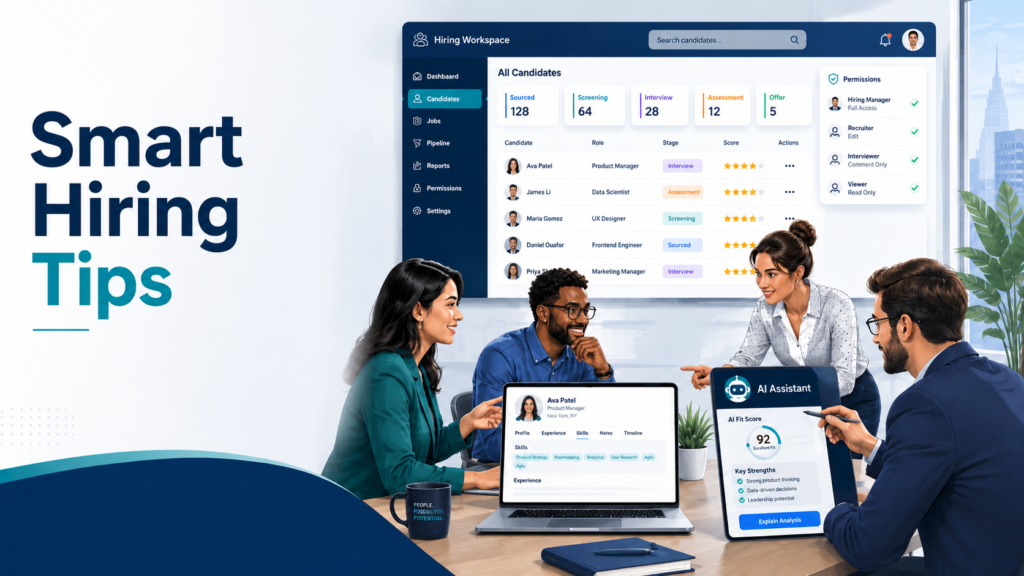
Hiring is no longer only about posting a job and waiting for applications. Employers now need faster systems, better teamwork, stronger candidate review, and careful use of technology. A smart hiring team is not built only with more people. Talent-traffic jam happens when companies add more recruiters, HR staff, and department managers without clear access, roles, and responsibilities. Smart hiring platforms reduce that chaos by helping teams add users quickly, assign permissions, search CVs, review candidates, and communicate with applicants without slow manual approvals. Hiring Area What Smart Teams Need Example Tools Fast access to hiring platforms and candidate databases Add recruiter seats, assign permissions, and track usage Teamwork Clear shared goals and communication Everyone knows the role, deadline, and candidate requirements AI Control Human review of AI-supported screening AI can shortlist, but recruiters should verify final suitability Compliance Fair and documented hiring process Keep records of candidate review, communication, and selection reasons Me-first hiring creates confusion when recruiters work separately without a shared goal, clear candidate criteria, or a common deadline. A strong hiring team works with a we-mindset, where everyone understands the role, required skills, business purpose, and timeline, making recruitment more accurate and organized. A smart hiring process should include clear job requirements, candidate sourcing, CV screening, document checking, interview coordination, employer feedback, final selection, onboarding support, and compliance records. Important points for smarter hiring teams: Clear access control: Give the right platform access to the right team members. For example, a recruiter may need CV search access, but an admin may only need reporting access. Shared hiring purpose: Explain why the role matters and what kind of candidate is needed. So, instead of saying “find warehouse workers,” mention experience numbers like shift, location, physical requirements, and document needs. Human review of AI results: Use AI to support screening, not to make the final decision alone. As a result, if AI rejects a candidate because of missing keywords, a recruiter should still check actual experience. Documented decision-making: Keep records of why candidates were shortlisted or rejected. For Instance, note missing certificate, weak experience match, salary mismatch, or incomplete documents. AI is now another major part of hiring. Many companies use AI tools for screening resumes, ranking candidates, writing job descriptions, or matching skills. There are 3 main controls every hiring team should follow. Recruiters should check whether the AI result makes sense. They should compare the candidate’s real experience, documents, skills, communication ability, and job readiness before submitting or rejecting a profile. If AI is used without control, it can damage trust with candidates and increase legal risk for employers. Responsible AI use means keeping human judgment at the center of recruitment. For recruitment firms this trend is very important. Employers want fast hiring support, but they also want reliable and compliant candidate screening. Agencies should focus on building verified candidate databases, clear internal task systems, and careful review processes. Companies that use AI without human review may face trust and compliance issues. But companies that combine digital speed with human judgment will be in a stronger position.